
Ductless Mini-Split Projects in Southern Utah
Mini-Split Installations in St. George
Garages that hit 130°F by noon. Casitas with no ductwork. Additions the builder never connected to the main system. These are the spaces where a ductless mini-split makes the most sense, and where Bret installs them most often.
Below are real mini-split installations Bret has completed in the St. George area. Each project started with the same question: what is the simplest, most reliable way to make this space comfortable year-round?
Project 1, Casita / Tiny Home
The Casita That Couldn't Stay Cool
The homeowner had converted a small structure into a livable casita, shiplap walls, a stone fireplace, a sleeping loft accessible by ladder. It was charming. It was also unbearable from May through September.
The problem was straightforward: no ductwork existed, and there was no practical way to run ducts into a space this small without destroying the interior aesthetic. A portable AC unit was creating condensation issues and couldn't keep up once outdoor temps passed 105°F.
Bret installed a Daikin wall-mounted head unit high on the wall near the entry door, positioned to distribute air across the open floor plan and up toward the loft. The unit's inverter compressor modulates output continuously, which matters in a small space: it maintains temperature without the uncomfortable blast-and-stop cycling that fixed-speed systems produce.
The line set runs through the exterior wall to a compact condenser outside. Total installation time was under five hours. The space now holds 72°F comfortably even when outdoor temperatures exceed 115°F, and the same unit provides heat through winter without a separate system.
_9ab2bd7d.webp)
Daikin wall-mounted head positioned near the ceiling line for optimal air distribution across the open floor plan and up to the loft.
Why Ductless Is the Right Answer for These Spaces
No Ductwork Required
Conventional split systems need supply and return ducts, which means soffits, chases, or dropped ceilings. In garages, casitas, and additions where none of that exists, a mini-split delivers conditioned air through a single wall penetration roughly 3 inches in diameter. No demolition. No drywall repair. No ceiling height lost to duct runs.
Inverter Efficiency
Inverter-driven compressors don't cycle on and off at full blast. They modulate, running at 30%, 50%, or 80% capacity depending on the load. This eliminates the energy spike of every startup cycle, reduces wear on the compressor, and maintains tighter temperature control. In a small space, this is the difference between comfort and constant temperature swings.
Heat Pump Capability
Every mini-split Bret installs is a heat pump. The same refrigerant circuit that removes heat in summer reverses direction in winter to provide heating. In Southern Utah's mild winters (lows in the 20s-30s), a mini-split heat pump delivers efficient heating without a furnace, gas line, or combustion venting. One system, both seasons.
Desert Heat Performance
Cheap mini-splits lose capacity as outdoor temperatures rise, some derate significantly above 105°F. The Daikin units Bret installs maintain rated cooling output at outdoor temperatures up to 115°F because the inverter adjusts compressor speed rather than shutting down on high-pressure lockout. This matters in St. George where 110°F+ days are routine from June through August.
_08ea05dd.webp)
Daikin outdoor condenser mounted on wall brackets against the workshop exterior, elevated off the ground to prevent debris accumulation and allow proper airflow around the coil.
Project 2, Detached Workshop
The Workshop That Needed Year-Round Climate Control
This detached workshop with red board-and-batten siding served as a combination hobby shop and home office. The owner spent 4-6 hours a day inside during summer, and was losing productivity to heat exhaustion by mid-morning.
The structure had no existing HVAC infrastructure. No ducts, no furnace, no return air path. The only option that didn't require tearing into the walls and ceiling was a ductless mini-split.
Bret mounted the outdoor condenser on wall brackets rather than a ground pad, a deliberate choice for this location. Wall-mounting keeps the unit above grade where landscaping debris, mud daubers, and monsoon runoff can't interfere with the coil. The insulated line set penetrates through the siding and connects to the indoor head inside.
The electrical was run from the home's main panel to a dedicated disconnect at the condenser location. The system now maintains 74°F inside while the exterior wall temperature exceeds 140°F in direct afternoon sun, and provides supplemental heat during winter months when the owner works early mornings.
Project 3, Garage Workshop
The Garage That Hits 130°F by Noon
Detached garages in Southern Utah are heat traps. Concrete slab radiating stored thermal energy upward. Metal garage door absorbing direct sun. Minimal insulation in the walls and ceiling. By 11 AM on a July day, the interior temperature can exceed 130°F, hot enough to warp wood, damage electronics, and make the space genuinely dangerous for extended work.
This homeowner used the garage as a serious woodworking shop. Table saw, planer, drill press, hand tools, thousands of dollars in equipment sitting in conditions that accelerate rust and degrade lubricants. He needed real climate control, not a box fan pointed at a bucket of ice.
Bret installed a higher-capacity Daikin unit sized for the thermal load: a large, poorly insulated volume with massive heat gain from the garage door and concrete slab. The indoor head is mounted high on the back wall with the line set running down through a clean line set cover to the exterior penetration.
The key sizing consideration: garages need more BTU per square foot than living spaces because insulation is minimal and the garage door creates a massive thermal bridge. Bret calculated the load based on actual conditions, not a generic square-footage chart, and selected a unit that maintains setpoint even with the door opened briefly for material loading.
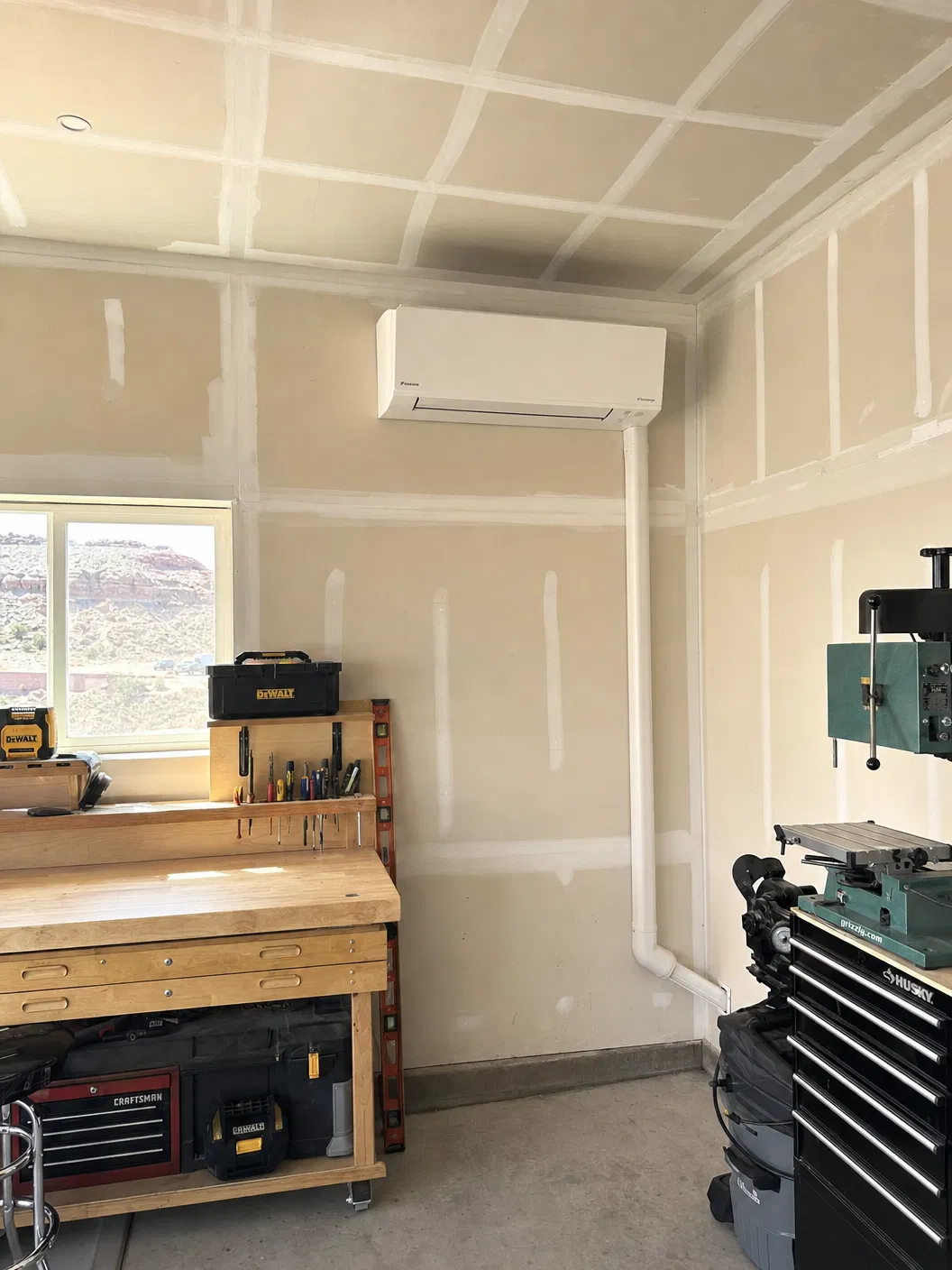
Indoor head mounted high on the back wall of a garage workshop, positioned to push cooled air across the full depth of the space. Line set cover provides a clean, protected path to the exterior.
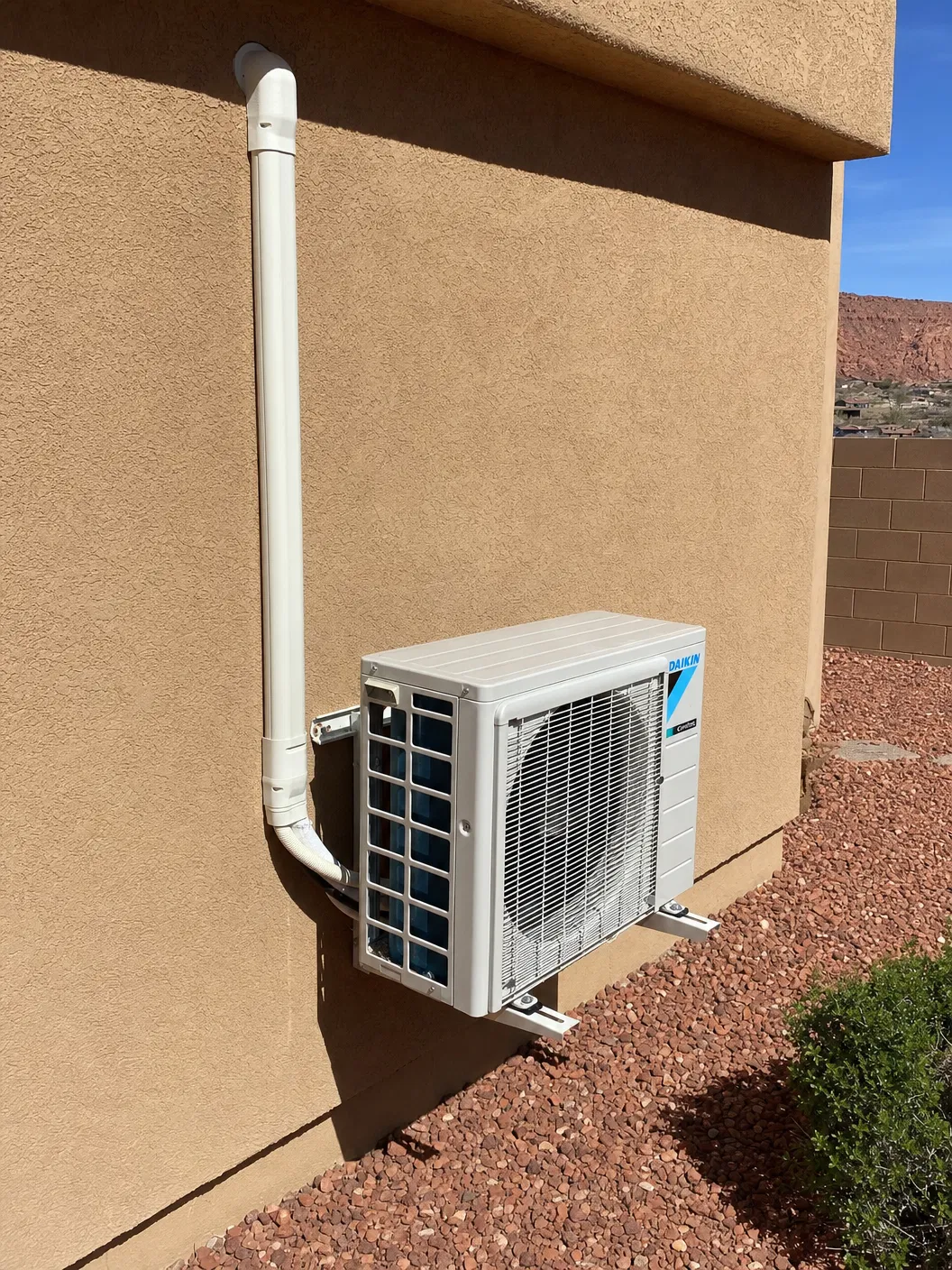
Outdoor condenser on wall brackets with a clean vertical line set cover run, installed against stucco without cracking or compromising the wall's weather barrier.
Project 4, Home Addition
The Addition the Builder Never Connected
When this home was expanded with a bonus room addition, the builder never extended the existing duct system to serve the new space. The homeowner assumed it would be handled, it wasn't. The room had electrical, drywall, and flooring, but no way to heat or cool it.
Extending the existing ductwork would have required cutting into finished walls, potentially upsizing the existing air handler's blower, and rebalancing airflow to every room in the house. The cost and disruption would have been significant, and the existing system was already at capacity for the original square footage.
A dedicated mini-split was the cleaner solution. Bret core-drilled through the stucco exterior, a process that requires care to avoid cracking the surrounding finish, and ran the line set through a UV-resistant cover vertically down to the wall-mounted condenser. The condenser sits on heavy-duty brackets with proper clearance from the wall for airflow and maintenance access.
The result: the addition has its own independent climate control that doesn't tax the main system. The homeowner can set a different temperature in that room without affecting the rest of the house, which is particularly useful for a space used as a home office during the day and a guest room at night.
What Bret Evaluates Before Recommending a Mini-Split
Not every space needs a mini-split, and not every mini-split is sized correctly for the space it serves. Before recommending equipment, Bret evaluates:
Thermal Load
Square footage, ceiling height, insulation quality, window area and orientation, heat-generating equipment inside the space. A 400 sq ft insulated office needs a very different unit than a 400 sq ft uninsulated garage with a west-facing metal door.
Electrical Capacity
Mini-splits require a dedicated circuit, typically 20A or 30A at 240V depending on the unit size. If the electrical panel is full or the structure has no existing 240V service, that work needs to happen first. Bret identifies this upfront so there are no surprises on installation day.
Line Set Routing
The refrigerant lines connecting indoor and outdoor units have a maximum allowable length (typically 50-75 feet depending on the model). Longer runs reduce efficiency and require additional refrigerant charge. Bret plans the shortest, cleanest path that avoids aesthetic issues and structural complications.
Condensate Management
The indoor unit produces condensation that must drain somewhere. In a living space, this usually means a gravity drain through the wall. In a garage or below-grade installation, a condensate pump may be required. Improper drainage is the number one cause of mini-split water damage, and it's entirely preventable with proper planning.
Outdoor Unit Placement
The condenser needs adequate airflow clearance, protection from direct afternoon sun when possible, and a mounting surface that won't transmit vibration into the structure. Wall brackets, ground pads, and elevated platforms each have appropriate applications depending on the site conditions.
Why Bret Installs Daikin
Bret has installed mini-splits from multiple manufacturers over 30 years. He recommends Daikin for residential installations in Southern Utah for specific, practical reasons:
Compressor warranty: Daikin backs their inverter compressors with a 7-year parts warranty (12 years with registration). The compressor is the most expensive component to replace, warranty coverage matters.
High-ambient performance: Daikin units maintain rated capacity at outdoor temperatures up to 115°F. Cheaper brands derate or shut down on high-pressure lockout above 105°F, which is exactly when you need cooling most.
Inverter reliability: Daikin manufactures their own compressors (most brands buy from third parties). Vertical integration means tighter quality control on the component that determines system lifespan.
Quiet operation: Indoor sound levels at 19 dB on low fan speed, quieter than a whisper. This matters in bedrooms, offices, and casitas where the unit runs continuously at low output rather than cycling on and off.
Bret is not a Daikin dealer or sponsored installer. He recommends the brand because it performs reliably in the conditions his customers actually live in.
What Customers Say About Working With Bret
These real customer reviews reflect the kind of experience Bret provides: honest guidance, fair pricing, and no pressure to buy equipment you don't need.
"Top quality service and priced at a much better rate than all other competitors in the area. On time and efficient. Very upfront and honest about the cost, installation time, and responsive with all questions."
, Wesley M.
"After another company tried to scam us by pressuring us into a big, expensive replacement, we asked Bret to give us a second opinion. He came over quickly, was informative, took the time to show us what he was looking at, and quoted us pricing that was over 50% cheaper than what we'd been quoted."
, Sadie L.
"Bret was amazing! He came out last minute when our AC went out on a hot August Friday afternoon in order to prevent us having to spend the weekend without AC. He was super honest with his recommendations and didn't try to upsell things we didn't need. Others I called did, unfortunately. His prices were also better."
, Garrett B.
Mini-Split Pricing in St. George
Mini-split pricing depends on the unit capacity, brand, efficiency rating, line set length, electrical requirements, and installation complexity. Bret uses ballpark ranges to help homeowners plan, these are starting points, not final quotes:
Single-zone mini-split (one indoor head, one outdoor condenser)
Typically starts around $5,000 for a standard installation with existing electrical access and a short line set run.
Multi-zone system (2-3 indoor heads, one outdoor condenser)
Typically starts around $8,000–$12,000 depending on the number of zones, unit capacities, and routing complexity.
Factors that increase cost
Electrical panel upgrades, long line set runs (40+ feet), difficult wall penetrations (concrete, stone), elevated condenser mounting, permit requirements, and higher-capacity units for large or poorly insulated spaces.
Bret will not treat a ballpark number like a final quote without looking at the actual situation. For detailed pricing, see the Mini-Split Installation service page.
Spaces Where Mini-Splits Make the Most Sense
Detached Garages
No ductwork path from the main house. Extreme heat gain in summer. A mini-split provides independent climate control without running ducts across the yard.
Casitas & Guest Houses
Small structures that need year-round comfort but lack the infrastructure for a conventional system. One wall-mounted unit handles both heating and cooling.
Home Additions
When the existing HVAC system is already at capacity and can't serve additional square footage without being upsized or rebalanced.
Home Offices
Rooms that need cooling during work hours but not at night. A mini-split lets you condition one room without running the whole-house system.
Bonus Rooms Over Garages
These spaces are notoriously uncomfortable, hot in summer, cold in winter, because they sit above an unconditioned garage with minimal insulation.
Workshops & Studios
Art studios, music rooms, woodshops, spaces where temperature and humidity control protects both the occupant and the materials inside.
Frequently Asked Questions
Related Services
Mini-Split Installation
Full service page with pricing, process, and what to expect from a ductless installation.
Learn moreAC Replacement
When the main system needs replacing, full condenser and coil swap for the whole house.
Learn moreAC Replacement Projects
See real AC replacement examples from homes in the St. George area.
Learn moreThinking About a Mini-Split?
Call or text Bret and describe the space you want to condition. He'll tell you whether a mini-split makes sense, what size you likely need, and what the installation would involve, without pressure, without a sales pitch, and without inventing urgency.
(435) 549-1409